
A service crew job description defines the duties, skills, and expectations for frontline workers in hospitality and food and beverage service. In Singapore’s fast-moving F&B sector, this role covers everything from greeting guests and taking orders to handling transactions and maintaining hygiene standards. The industry term for this position is “food service associate” or “F&B service staff,” though “service crew” is the standard label used across Singapore’s restaurants, cafes, hawker-style dining chains, and fast food outlets. Whether you are exploring your first job or considering a move into hospitality, understanding what this role actually demands will save you time and set you up to succeed.
What are the primary responsibilities of a service crew member?
Service crew duties cover the full customer journey from arrival to departure. The role is not limited to taking orders. It spans every touchpoint a guest has with the establishment.
Core daily responsibilities include:
- Greeting and seating guests promptly and with a professional attitude, setting the tone for the entire visit
- Taking accurate orders and entering them into a point-of-sale (POS) system, which reduces kitchen errors and speeds up service
- Serving food and beverages according to the outlet’s presentation standards, including correct plating and temperature checks
- Handling cash and card transactions accurately, including processing refunds and issuing receipts
- Maintaining cleanliness of dining areas, service stations, and restrooms throughout the shift
- Supporting opening and closing duties such as restocking condiments, checking inventory levels, and setting up tables
- Managing customer feedback by listening actively, resolving minor complaints on the spot, and escalating serious issues to a supervisor
Core duties also include inventory checks and managing customer feedback as standard expectations, not optional extras. This means crew members carry operational weight beyond what guests see.
Pro Tip: Memorize the menu’s top five items and their allergens in your first week. Guests ask about ingredients constantly, and a confident answer builds trust faster than any scripted greeting.
What key skills and qualifications are required for service crew jobs?
The service crew skills required go well beyond friendliness. Employers in Singapore’s F&B sector look for a specific combination of practical ability and personal character.
- Interpersonal and communication skills. Crew members interact with dozens of guests per shift. Clear, polite communication prevents misunderstandings and reduces order errors.
- Basic math and cash handling. Accurate change-giving and transaction processing protect both the business and the guest. Errors here create friction and damage trust.
- Physical stamina. Physical stamina is more critical than technical skill, with crew members standing and walking throughout shifts, often in high-temperature kitchen-adjacent environments. This is not a desk job.
- Multitasking under pressure. Balancing multiple tables, tracking order status, and responding to guest requests simultaneously is a core daily reality.
- Teamwork and adaptability. Shifts change, colleagues call in sick, and peak periods hit without warning. Crew members who adapt quickly keep operations stable.
- Food safety and hygiene knowledge. Food safety certification is often mandatory or strongly preferred to meet regulatory requirements. In Singapore, this typically means completing a recognized food hygiene course before starting work.
Educational background and experience expectations
Most entry-level service crew roles require a high school diploma or equivalent, with no prior experience needed. Fresh graduates and students are typical candidates. Employers expect willingness to work shifts including weekends and public holidays. Training is usually provided on the job, covering POS operation, menu knowledge, and hygiene protocols.
Pro Tip: If you do not yet hold a food hygiene certificate, complete one before applying. It signals seriousness and removes a common hiring barrier at no significant cost.
How does the service crew role impact restaurant operations and guest experience?
The service crew position description often undersells the operational weight this role carries. Crew members are not just order takers. They are the primary interface between the kitchen and the guest, and their performance directly shapes the outlet’s reputation.
“Service in the hospitality context means managing guest perception at every moment. When a crew member anticipates a guest’s needs, such as refilling a water glass before it empties, they signal attentiveness that no marketing campaign can replicate. This proactive behavior improves both customer satisfaction and service efficiency.”
Consistency across a full shift separates average outlets from well-regarded ones. Consistency in service and hygiene adherence throughout shifts is a primary performance indicator for service crew members. The ability to maintain standards from the first table of the day to the last distinguishes top performers from those who fade under pressure.
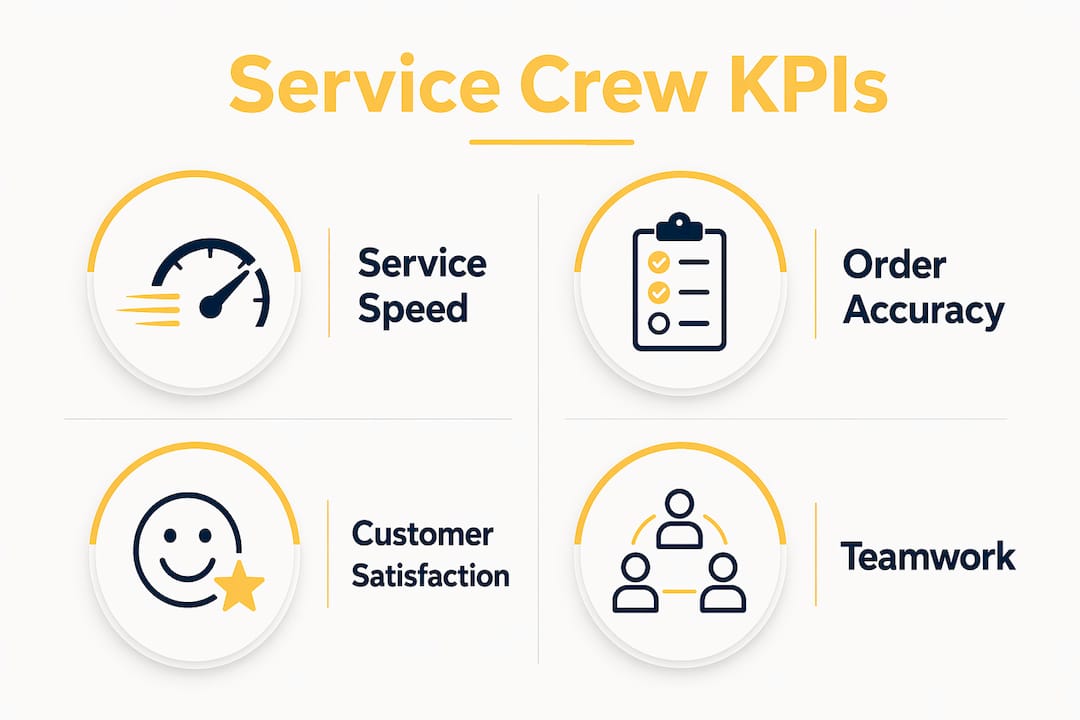
Key performance indicators for service crew
| KPI | What it measures |
|---|---|
| Service speed | Time from seating to first contact and order delivery |
| Order accuracy | Percentage of orders delivered correctly on the first attempt |
| Hygiene compliance | Adherence to cleaning schedules and food handling protocols |
| Guest satisfaction | Feedback scores, repeat visits, and complaint frequency |
| Team contribution | Reliability, punctuality, and support for colleagues during peak periods |
Collaboration with kitchen staff is equally critical. Crew members relay special requests, communicate delays honestly, and flag quality issues before a plate reaches the table. Problem-solving skills during live service, such as managing a wrong order or a long wait, directly affect whether a guest returns or leaves a negative review.
High-volume periods, like weekend lunch rushes or public holiday dinners, test every skill simultaneously. Crew members who balance speed and quality during peak periods support the entire team’s success, not just their own section.
What are the work conditions and career growth opportunities?
Service crew job requirements include accepting a work environment that most office workers never experience. Understanding these conditions before you apply prevents early burnout and sets realistic expectations.
Typical work conditions include:
- Shift-based scheduling covering mornings, afternoons, evenings, and sometimes overnight, depending on the outlet’s operating hours
- Weekend and public holiday availability as a standard expectation, not an occasional request
- Extended standing and walking throughout shifts, often for six to eight hours with minimal seated breaks
- High-temperature environments near kitchen areas, requiring physical endurance and attention to personal hydration
- Fast-paced, high-pressure periods during meal rushes where multitasking and composure are tested simultaneously
- Team-dependent workflows where one person’s performance affects the entire shift’s outcome
Career progression in Singapore’s hospitality sector follows a clear path for crew members who perform consistently. Starting as a service crew member, you can move into a senior crew or team leader role within six to twelve months. From there, supervisor, assistant manager, and outlet manager positions become accessible. Many F&B managers in Singapore began their careers taking orders at a counter.
A positive and resilient attitude is prioritized over technical experience for service crew roles because the demanding nature of the job filters out candidates who rely on credentials alone. Employers promote people who show up reliably, handle pressure without complaint, and treat colleagues with respect. Those qualities are visible from the first week on the job.
Upskilling opportunities also exist through employer-sponsored training in barista skills, food preparation, and customer service certification. Singapore’s Workforce Skills Qualifications (WSQ) framework offers hospitality modules that crew members can complete while working, adding formal credentials to practical experience.
Key Takeaways
A service crew role demands physical stamina, consistent hygiene standards, and strong interpersonal skills, making attitude and reliability more valuable than prior experience.
| Point | Details |
|---|---|
| Core duties span the full shift | Responsibilities include greeting, ordering, serving, cleaning, and closing tasks every day. |
| Stamina matters more than credentials | Physical endurance and a positive attitude outweigh formal qualifications for entry-level hiring. |
| Food safety certification is expected | Completing a recognized hygiene course before applying removes a common barrier to employment. |
| Anticipatory service drives performance | Proactively meeting guest needs before they ask separates top crew members from average ones. |
| Career growth is real and structured | Consistent performers can reach supervisor and manager roles within one to two years. |
What I have learned from watching service crew members succeed and fail
The single biggest mistake I see aspiring crew members make is treating this role as temporary filler work. That mindset shows up immediately in how they carry themselves on the floor, and experienced managers spot it within the first shift.
The crew members who advance fastest are the ones who treat every table like it matters. They learn the menu faster than required, they notice when a colleague is overwhelmed and step in without being asked, and they never let a guest see them stressed. That composure under pressure is not a personality trait you either have or do not. It is a skill built through repetition and intention.
Anticipatory service is the clearest marker of a high performer. Refilling a drink before the guest notices it is low, bringing extra napkins to a table with young children, checking back after a dish arrives rather than disappearing. These behaviors cost nothing and signal everything about a person’s work ethic.
Physical preparation is also underestimated. Crew members who invest in proper footwear, stay hydrated, and eat before shifts last longer and perform better. The ones who ignore the physical demands burn out in weeks, not months.
Mastering the basics of this role opens more doors in Singapore’s hospitality sector than most people realize. The F&B industry here is large, well-organized, and full of operators who promote from within. A crew member who performs well for twelve months has a genuine path to management. That is not a promise every industry can make.
— Lukas
Employstreet connects you with service crew roles in Singapore
Singapore’s F&B and hospitality sector moves fast, and finding the right crew position through the right channel makes a real difference to how quickly you start working.

Employstreet is a Singapore-based staffing specialist built by industry insiders who understand exactly what F&B operators need and what crew candidates want. The platform connects job seekers directly with hospitality employers across restaurants, cafes, and food service outlets, cutting out the guesswork of cold applications. Whether you are entering the industry for the first time or returning after a break, Employstreet’s F&B recruitment service matches your availability and skills to roles that fit. Visit Employstreet to browse current openings and get placed faster.
FAQ
What does a service crew member do on a typical shift?
A service crew member greets guests, takes and enters orders into a POS system, serves food and beverages, handles payments, and maintains cleanliness throughout the shift. Opening and closing duties such as restocking and inventory checks are also standard.
What qualifications do you need for a service crew job?
Most service crew roles in Singapore require a high school diploma or equivalent, with no prior experience needed. A food hygiene certificate is often mandatory or strongly preferred before starting work.
What skills are most important for service crew roles?
Strong interpersonal communication, physical stamina, basic math for cash handling, and the ability to multitask under pressure are the most critical skills. Teamwork and adaptability in fast-paced environments are equally valued by employers.
Can a service crew job lead to a management career?
Consistent performers can move from crew member to team leader, supervisor, and outlet manager within one to two years. Singapore’s hospitality sector actively promotes from within, and many current F&B managers started in frontline crew roles.
Is food safety certification required for service crew positions in Singapore?
Food safety and hygiene certification is frequently required or strongly preferred by employers to meet regulatory standards. Completing a recognized food hygiene course before applying strengthens your application significantly.